
Cat 2D & 3D machine control
The operator works to the design on screen, not to string lines.
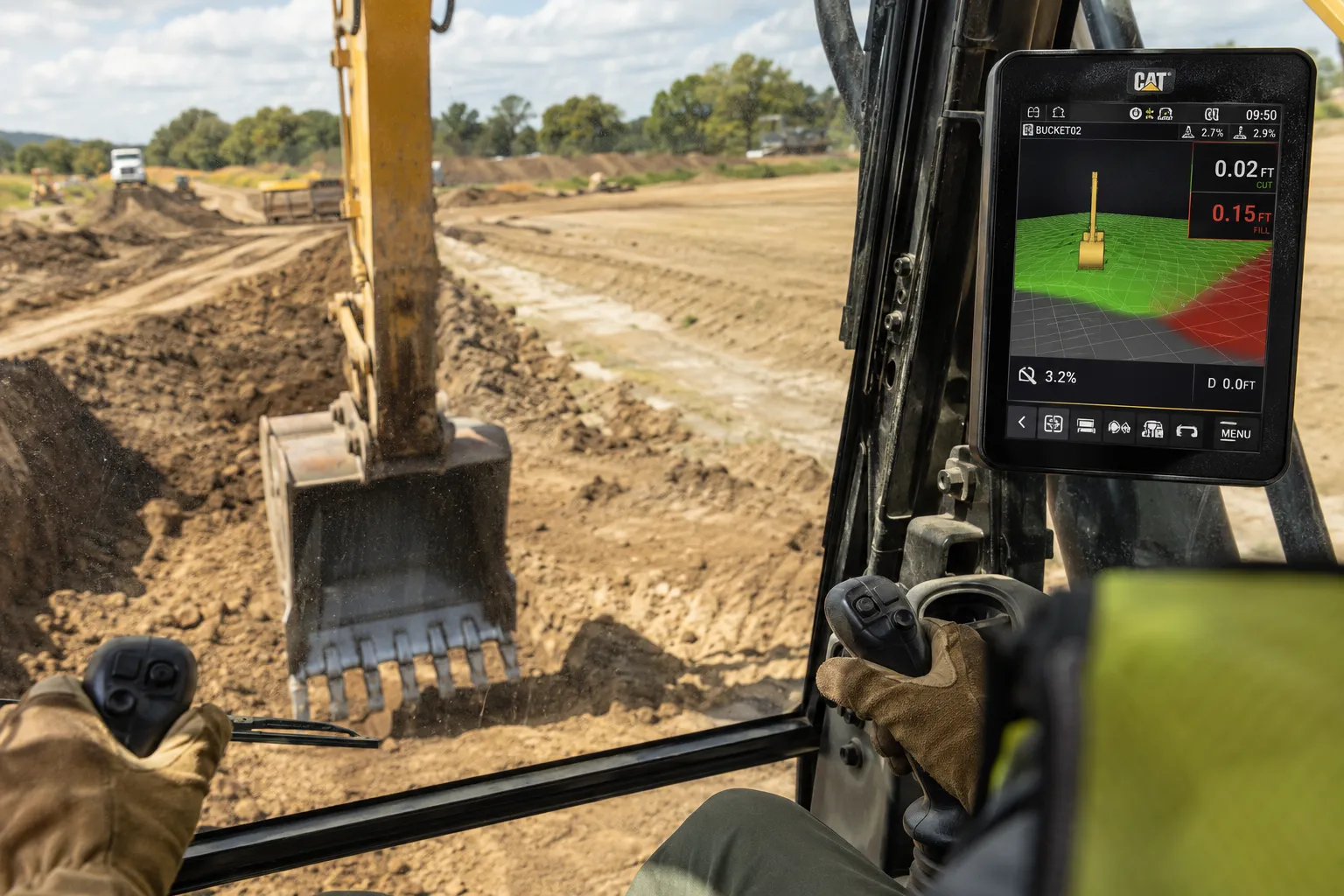
On a machine without guidance, the operator digs to pegs and string lines, then someone hops down with a level to check it, then they dig again. Every check is a stop, and every stop costs you money.
Machine control puts the design inside the cab. A screen shows where the bucket is relative to the level it’s meant to reach — how deep, how far off grade, which way to move. The operator can see the finished shape before it exists, and work straight to it.
We run the full Cat system, in both 2D and 3D.
2D — depth and slope
2D handles the jobs defined by a depth and a fall rather than a full design: trenches to invert level, a pad off a known benchmark, a driveway at a set grade. The operator sets a reference and works to it, and the machine tracks depth and slope continuously without anyone getting out to measure.
It’s fast to set up and precise on depth, which makes it the workhorse for a lot of everyday work — on and cutting within minutes of tracking onto site.
3D — the whole design surface
3D uses GPS positioning against a complete 3D model of the finished site. The machine knows exactly where it is on your block, and the operator sees the entire design surface — every level, fall and batter — not just one reference.
That’s what you want for building pads, complex site cuts, anything with multiple levels tying together, or work where the as-built record matters.
Because we run both, every job gets the system built for it — the speed and depth accuracy of 2D where the work is defined by a level and a fall, the full design surface of 3D where levels have to tie together across a site. Either way you get the same result: ground that’s right when we leave.
What it doesn’t change
Guidance doesn’t operate the machine. It tells a good operator exactly where they are; it doesn’t tell them how to dig, how to read ground conditions, or when to stop and ring you. That part is still the person in the seat, and it is the part experience earns rather than equipment.